


April 11, 2026
How to Build an AI Marketing System for a Service Business
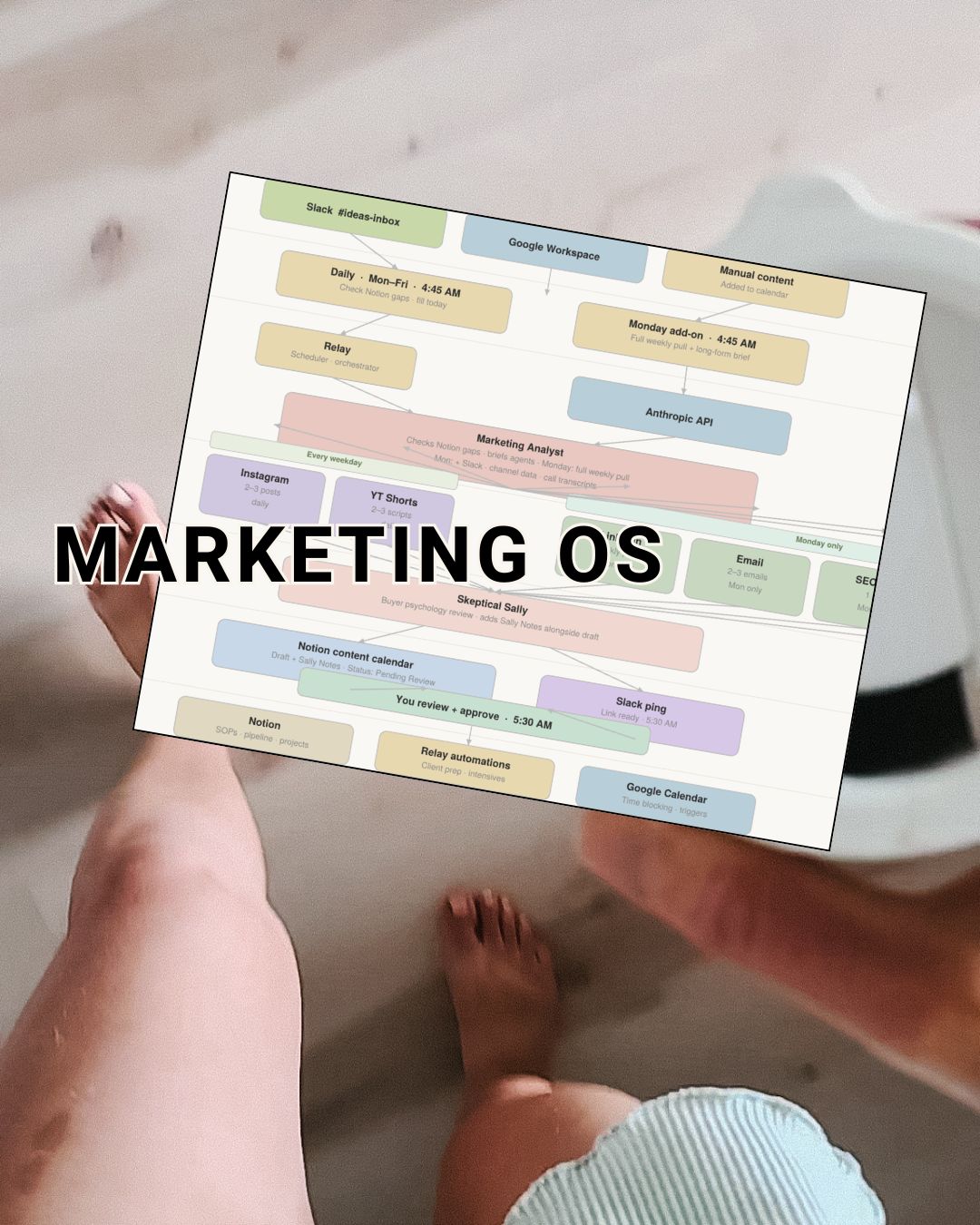
Inside my AI marketing system as a 1-person consultant
You’ve been doing the marketing yourself. Writing the posts. Drafting the emails. Trying to stay consistent between client work, admin, and whatever’s happening in your life outside the business. But at some point, effort stopped being the solution. If you’re here, you probably have a hunch there’s a better way. But most of the advice you’ll find about how to build an AI marketing system is for teams—people with a dedicated ops hire, a content manager, a budget for a stack of SaaS tools. It’s complex and overwhelming.
Or, you see people bragging that they could let go of their entire marketing team to run an AI marketing team instead. That’s not what this is.
This is what a simple, functional AI marketing system looks like when you’re running a service business and you’re tired of being the bottleneck in your own growth.
👉 Want to see how I run my agent-native business? Watch how the agentic OS works here & download a free diagnostic to start integrating AI agents into your business.
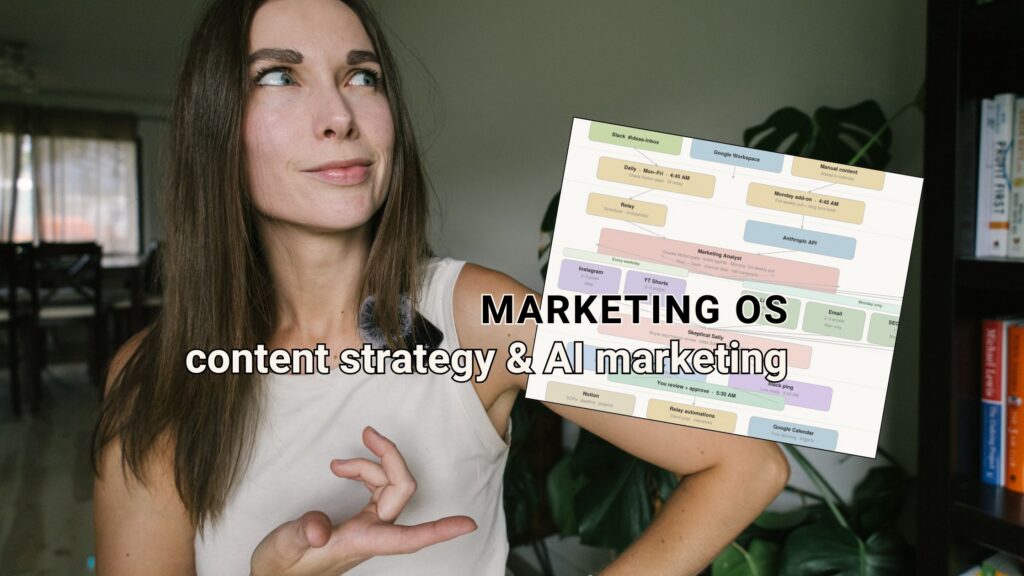
Watch a demo of my AI Marketing OS
I know this AI marketing talk can be a lot, so if you’d rather watch, TAP HERE.
What an AI marketing system is, and how it works
A marketing OS (operating system) isn’t your content calendar. It’s not a custom GPT. It’s not a list of tools you’re subscribed to. And it’s more than prompting ChatGPT every time you need a caption and hoping for the best… Just to rewrite the output after because it sucks.
An AI marketing system is custom infrastructure. A connected set of systems and agents that handle the repeatable parts of your marketing without you having to be present for every step. They have access to skills, tools, and connectors so they can perform tasks on a schedule or in reaction to triggers.
Think of it the way you’d think about hiring a highly trained junior team. Except these team members need minimal onboarding, don’t often get behind, and remember the updates you give them. They’ve been built around your strategy, your voice, your audience, and your goals. They show up the same way every time, and can even get better every week.
Plus they can be run by that same junior when installed well.
I built this system so my clients don’t need to have me manage everything for them. When the system is plugged in and customized, they or a team member can oversee and manage everything it creates.
The distinction matters because most founders who say they’re “using AI for marketing” are still doing all the strategy and organizing themselves, and just outsourcing the typing. Sorry to be the one to break it to you, but that’s not leverage. That’s a faster keyboard that exists in the silo of ChatGPT.
A real AI marketing system removes you from the loop on things that are trained on your standards, but don’t require your judgment at every step, so you can spend your actual mental energy on the things that do. It also operates out of a dedicated RAG system, which is basically a second brain of relevant context for your business. Building it this way with the separate context also is helpful for making your system platform agnostic.
Claude could go down tomorrow, and I can take my system prompts and second brain, then connect it to another option.
What is AI marketing?
There’s bad AI marketing that you see in the form of slop on the internet. Then there’s marketers like me who turn our IP into intelligent marketing systems. The difference is that my AI marketing system consistently gets content 70-80% there from the first install. It’s not slop. It’s like a junior who needs some tweaking and training.
Which is also why I run self-learning loops on a schedule for most of my agents.
And I think it’s really cool that this is even possible because it allows more solo and small businesses to create more. To show up more and reach more people. Budgets and capacity used to hold small businesses back, but it doesn’t need to now.
What’s inside an AI marketing system
Here’s what mine runs on! This was built and iterated over the last year inside a 1-person consulting practice.
The Analyst. Every Monday morning, an agent pulls from multiple sources: call transcripts, the content bank, the social calendar, trending signals in the feed, and recent platform data to deliver a full weekly brief. Not a list of ideas. A strategic brief: what to publish, in what order, why it matters this week, and which posts are most likely to drive the right attention. By the time I sit down to work, the thinking is already done.
Before this existed, I was spending the first hour of every Monday trying to orient myself. Scrolling back through notes, checking what I’d posted last week, trying to remember what had performed. Now that hour is gone. I use it to create original ideas instead that can feed the system or my other projects.
Content agents by platform. LinkedIn, Instagram, Email, SEO Blog, YouTube Shorts. Each channel has its own agent that understands the format, the algorithm priorities, the CTAs that work, and how my voice lands on that platform. I don’t write LinkedIn posts from scratch. The analyst briefs the agent. The agent drafts. I refine and post.
The difference from a generic AI writing tool is that these agents aren’t starting from zero. They know my frameworks, my audience, my tone rules, and the specific things I never say. The output sounds like me because it was built around my ecosystem. This works really well if you already have an archive of content to pull from.
The Call Content Scout. Every client and discovery call gets transcribed. The Scout reads those transcripts and surfaces content ideas, recurring objections, language my audience actually uses, and positioning gaps I should be addressing. That’s months of audience research happening automatically in the background.
What this replaced: hours of manual note review after calls, ideas that lived in my head and never made it to a post, and the constant feeling that I was creating content I thought people wanted instead of content pulled directly from what they legitimately say.
Skeptical Sally. Before I review anything, Skeptical Sally takes a pass. She started as a custom GPT—a happy accident I built while presenting to a live group of business owners. I took a chance to see if we could solve some problems for people, and this is what we created.
This Skeptical system prompt became the foundation for the buyer-psychology trained subagent in my Marketing OS. Sally leaves comments on drafts about authority, credibility, trust, believability—and suggestions to improve.
Since buyers are more hesitant, and very mature in many industries, Skeptical Sally helps alleviate that resistance.
The Slack Communication Channel. When everything is ready to go, my Marketing OS agent pings me in Slack to say it’s all good. I’m also able to send my agent messages through Slack to improve for the upcoming week, add content suggestions, angle ideas, etc. It’s a catchall for comms.
The constraint is the size of the question you bring to it
Most founders using AI are solving small problems.
- Rewrite a caption.
- Summarise an email thread.
- Generate 5 subject line options.
The founders getting measureable leverage are bringing it bigger problems.
- Structure an entire content strategy.
- Replace a manual onboarding sequence.
- Build a system that generates their weekly editorial brief from live data.
The effort is roughly the same. A well-prompted, well-trained agent takes about the same amount of time to build whether it’s solving a small problem or a significant one.
The difference is what you get back.
When you bring AI a small problem, you save a few minutes. When you bring it a structural one, you get hours back every week from here on out.
This is what I mean when I say most founders are thinking too small with AI. It’s meant to help you reframe. The same energy you’re spending to get a slightly better Instagram caption could be going toward building something that runs your entire content operation while you’re on a hike with your kids.
The constraint isn’t the tool… you’re using it wrong. It’s the size of the question you’re willing to bring to it.
How to start building your AI marketing system
You don’t need to build everything at once. The Marketing OS I run now was built one agent at a time, starting with the highest-friction task in my week.
You could DIY something that works for you, or get my help to install something similar into your business.
Here’s the entire process step by step:
1. Identify your highest-friction marketing task.
What eats the most time, generates the most mental load, or falls off first when you get busy? That’s your starting point. Not the most complex thing, but the most expensive thing to keep doing manually.
For most service business owners, this is one of three things:
- content creation (specifically, deciding what to create and when)
- client onboarding admin
- or follow-up sequences that require personalisation but follow a repeatable pattern.
2. Map what that task actually requires.
What inputs does it need? What’s the output? Which decisions inside it require your genuine judgment. Versus which ones are just repeatable logic that you happen to be executing personally because no one else is doing it?
That second category is what you hand to an agent.
3. Build the smallest version that works.
It doesn’t need to be fancy or perfect to start. Not the one with every edge case handled. Build something that takes that 1 task off your plate this week.
4. Expand from there.
Once 1 agent is running well, you’ll see the next bottleneck clearly. That’s your next build. The system compounds.
Built on Claude and Scheduled on Claude Cowork
Claude is having a moment right now and people are jumping ship from ChatGPT, but honestly the 2 are so different. They have different purposes and use cases.
I use ChatGPT for:
- quick brainstorming and back and forth
- shareable customGPTs for clients (and ones you can purchase here)
- rough plans
Then I take summaries and plans into Claude to create the full picture. Then Claude helps me take action.
ChatGPT talks about the work. Claude does the work.
And Claude Cowork allows those agents to run on a schedule. I have multiple running in my business each day and week.
What to look for in AI tools for a one-person service business
Not every AI tool is built for the way you work. A few things worth filtering for before you invest time in a new platform:
It should work with your existing stack, not replace it. Connectivity and integration are the main challenges. The best AI systems aren’t built on entirely new infrastructure—they connect to the tools you’re already using. Google Workspace, Notion, your CRM, your email platform. If a tool requires you to migrate everything, the switching cost usually outweighs the gain.
I like Claude for this. I can have it add and update tasks in Notion, access my database of reference materials, generate content, etc.
It should be trainable on your voice and your context. Generic AI inputs = outputs generic content. The tools worth building on are the ones you can train on your frameworks, your brand, your audience language, and your specific business logic, so the output sounds like you, not like everyone else using the same tool.
It should reduce decisions, not add them. If a new AI tool requires you to make more micro-decisions to operate it than the task you were already doing manually, it’s not saving you anything. The goal is to take decisions off your plate, not to create a new category of management.
It should be built around your highest-leverage tasks, not the easiest ones. Automating caption writing is fine. Automating your weekly content strategy brief, your client onboarding, and your testimonial capture is a different order of magnitude. Start there.
The point isn’t the tool. It’s what it gives back.
I built a family inbox agent on nap time and checked it after a hike with my kids. It had done the work that would otherwise have been waiting on my phone when we got home.
My Marketing OS took a lot longer because there’s multiple agents working together to generate high-quality marketing materials (like this blog post!!). But it’s the same idea.
That’s what a real AI marketing system is for. I don’t want to run faster on the same hamster wheel, or publish more content than humanly possible and call it a strategy. I want to create leverage that repurposes business and marketing assets over and over again so I can reach more people, therefore help more people.
To give you your time back. Deliberately by design.
This is what intentional structure produces—not the aspiration of a freer life, but the mechanics of one. You build the system. The system runs. You do something else like projects that excite you. Or you know, rest? Nap?
If you’re running a 1-person service business and you’re ready to stop being the thing that holds your marketing together by sheer willpower, this is worth building.
Other resources to learn about Claude skills vs agents
I share a ton of free content online, and run a group program. Here are a few places to get started learning about Claude skills vs agents, and how to build both.
👉 AI Show & Tell streams live (most) Wednesdays, and is exactly like the name sounds. I share live demos of cool agentic systems myself and clients have built inside Claude, practical information about agentic AI, and my 5-layer framework to building agentic systems. Register and catch the replays here.
👉 When you’re ready to build your first agentic systems, join me inside Leverage Lab. This group program guides you through the entire process to build a business brain, connect Claude to your workspaces, and build systems that scale without more of your time. Learn more and register for the next cohort here.
👉 If you want help building and customizing something like this for yourself, learn more about my Intensives here.
👉 If you’re just getting started with integrating AI into your business, start with the AI-Ready Brand Brief. Download it here.


The emphasis on building around the highest-leverage tasks is useful. For a small service business, capturing customer questions and turning them into a consistent review or social-content workflow seems like a practical bridge between one-off marketing effort and a system that actually gives time back.
Totally agree!