



You’ve watched the demos. Someone on your feed built an “AI agent” that handles their whole inbox, and you tried to copy it. You wrote what you thought was a solid prompt, connected a tool or two. Maybe you downloaded some free Claude skills they sold you as agents, and waited for the same magic. But there’s a big difference between Claude skills vs agents.
Instead you got inconsistent output. Some days it nails your voice. Other days it sounds like it’s never met your business. You start wondering if you did something wrong, or if the whole “agent” thing is overhyped. People really have these things working for them?
As someone who has built a multi-agent orchestration from the ground up, and runs it every day… Yes. Agentic AI absolutely works when you build it well.
It’s not that you’re not techy enough… You started at the wrong layer and with incomplete advice. Agentic AI isn’t exactly set it and forget it, and it’s also not a straight copy / paste between businesses. You need to configure your agents to work for you specifically. Starting with Claude skills that map to your business.
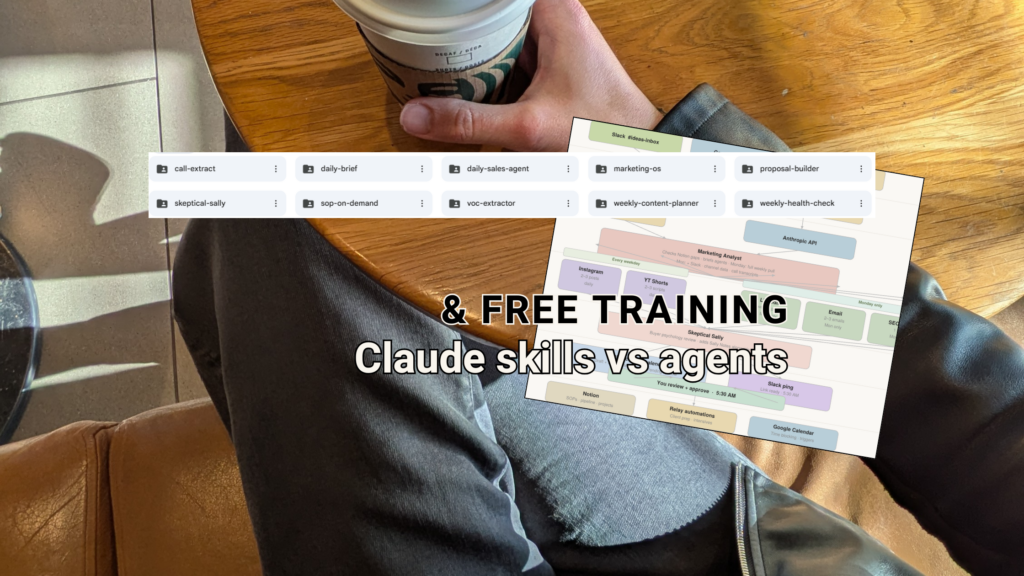
Free training: Claude skills vs agents
Catch the replay of AI Show & Tell, where I break down everything in this post and then some! I even show you exactly what’s in my Claude AI Skill File Library, and how you can swipe the pack for yourself.
What’s the difference between Claude skills vs agents?
I’ve answered this question enough times now—on AI Show & Tell, in emails, in DMs. Let’s document the full picture for you to reference!
The words Claude skills vs agents get thrown around interchangeably online, and it’s genuinely confusing. Most people explaining it are wrong, honestly.
Here’s the difference in plain terms.
A skill is a specialization. It’s the instructions, so Claude knows exactly how to do one specific thing, your way, every time. Think of it like a recipe card: step by step, no guessing, same result no matter who’s cooking. Or think of it like a diploma—it’s the specific training that makes someone qualified to do a specific job.
An agent is the thing doing the work. It reads the skill, picks up the right tools, and actually executes the task—sometimes across multiple steps, sometimes checking in with you along the way. One agent can have access to multiple skills.
Skill equals the specialization. Agent equals the worker who has access to that specialization, and follows the parameters it lays out.
Claude skill files are not agents on their own. They’re the specialized training your agents can use.
Why Claude skills have to come first
You need both Claude skills vs agents. But you really need skills first.
If your Claude skills suck, your Claude agents will suck too. Bad skills equal bad agents equal bad work. That’s a lose/lose/lose.
Trying to build agents before you’ve written a single skill is like hiring someone and giving them zero training, then wondering why the output is inconsistent. Nobody would do that with a human hire. We do it constantly with AI, because the tools make it feel like the thinking already happened somewhere upstream.
It didn’t. The thinking is the skill. Going deeper on context, and working through how something actually fits your business, wins over trying every new tool that launches this month. Every time.
By the time a skill is plugged into a bigger-picture agent, the specialization it has access to is on point because you did the work before you automated it, not instead of doing the work.
Why your Claude output still sounds generic (it’s not just the prompt)
I see this all the time… You wrote what you thought was a good prompt. You got it from a free download, so it must be good, right? But you got generic output back. So you blame the prompt, or you blame the model.
Your AI isn’t dumb. It’s starving.
It has nothing of yours to work from, so it pulls from the same internet as everyone else who typed a similar prompt this week. Generic context in, generic output out.
Context is the stuff that’s only yours—your customer segments, your decision frameworks, the whys and hows that live in your head. Everyone types similar prompts into the same models. Context is the one variable that actually produces a different output.
The kicker: you already have it. It’s just trapped where your AI can’t reach it. The chats that vanish when the tab closes, that one doc in Drive, the pinned Slack message, the brand brief you paid for a year ago and forgot about.
You call it digital clutter. I call it digital gold for training your AI to understand you and your business.
A Claude skill file is one of the ways you get that context out of your head and into something Claude can actually work from. Every time, not just the one good chat you happened to have on a Tuesday a few weeks ago and haven’t been able to find or replicate since.
Think of prompting AI as context engineering, not just prompt engineering. The prompts were never the power. Your context is. And a Claude skill is context, packaged so it survives past one conversation.
What a good Claude skill actually looks like
Let’s make Claude skills vs agents more tangible though because without clear examples, it’s still fuzzy to understand.
I used to run client proposals through Dubsado, a piece of software I paid for every single month, to send documents I still had to write myself. Sure, I had templates so there were fewer edits and clicks, but it was still either manual or traditional conditional logic. If this, then that.
I don’t pay for Dubsado anymore because my Claude skills and agents have replaced it.
The Proposal Builder is trained on the same proposal template that’s closed five-figure deals for me for years. Now it takes a discovery call and produces a finished, branded proposal, ready to send… without me touching it.
That’s the difference between a prompt and a skill. A prompt gets you one good answer. A Claude skill gets you the same good answer every time, without you babysitting it all the time or repeating yourself at nauseum.
I run multiple agents that have access to even more skills day to day. One reads a call transcript and puts every commitment anyone made straight onto my task board, with the exact quotes and who said what. Another looks at my pipeline every morning and picks my top 3 sales moves for the day. Another takes a system I just finished building and documents it before I forget how it works.
Claude skills are not agents on their own. They’re what makes the agents I do run worth having.
Claude skills vs agents for small business
Anthropic launched Claude for Small Business earlier this year. It’s a set of prebuilt agentic workflows and skills aimed squarely at businesses under 50 people. Search interest in this whole category is climbing fast, and most of what’s been written about it so far is generic listicles from people who’ve never actually run a business on it.
You don’t need to be technical to build a skill. You need to be specific about how you already do things well. You already know what you do every day, you just haven’t written it down anywhere Claude can access so your AI agents can take tasks off your plate.
How to build your first Claude skill
Where do you start? I get it. It’s overwhelming when you’re already at capacity because now you need to make time to build too.
I like to choose things that either immediately save you time or make you money, so you can put those resources into better things.
Pick the task you already do the same way, over and over, that you could explain to a new hire without thinking twice. That repetition makes it easy because if you’re doing it identically each time, Claude can learn to do it identically too. The tasks with more nuance can be automated too, but you’ll figure out what works if you start with the easy stuff first.
Training AI agents is like training human team members
After you’ve decided where you start, write it down like you’re training a junior, not prompting a chatbot. That means:
- The specific job it’s doing, stated plainly. Not “help with marketing,” but “read a sales call transcript and draft a proposal using this exact structure.”
- The standard expected of it. This requires your actual template, your actual tone, a real example of what “good” looks like from your own work, not a generic best practice.
- The steps in order, the same way you’d walk a new hire through it the first time, including the parts that feel too obvious to write down. Those are usually the parts that matter most.
What “done” looks like, so Claude (and you) know when the job is truly finished, not just attempted. Claude skills might start out at 50% accuracy, but you want to get those up to 70% – 90% as soon as possible.
Start a fresh conversation with Claude, hand it that skill, and give it something real to work on. If the output isn’t what you want, now you know the gap between what you know and what you wrote down. Fix the skill and run it again. Repeat that until you’re happy with what it produces.
Claude skills vs agents—what do you need first?
Everyone is selling AI agents right now, and most of them are skipping the part that actually makes agents work. Skills aren’t the exciting part, but they’re the part that makes the exciting part possible.
If you want a shortcut past a year of trial and error, I built a library out of 10 of my favourite Claude skill files I use to run my own business. They cover everything from content, sales pipeline, client onboarding, the works. Installation instructions are built into each file, so you drop it into a new conversation with Claude and it walks you through setup from there. Grab the Claude AI Skill File Library here.
Not ready for that yet? Start with the free AI systems diagnostic. If you do this work, it will show you exactly where to start based on what’s actually happening in your business right now, not a generic checklist.
Other resources to learn about Claude skills vs agents
I share a ton of free content online, and run a group program. Here are a few places to get started learning about Claude skills vs agents, and how to build both.
AI Show & Tell streams live (most) Wednesdays, and is exactly like the name sounds. I share live demos of cool agentic systems myself and clients have built inside Claude, practical information about agentic AI, and my 5-layer framework to building agentic systems. Register and catch the replays here.
When you’re ready to build your first agentic systems, join me inside Leverage Lab. This group program guides you through the entire process to build a business brain, connect Claude to your workspaces, and build systems that scale without more of your time. Learn more and register for the next cohort here.